Sandra L. Bloom, M.D.

Power · Development · Democracy

The Social
Immune System

How Predatory Power Captures Democracy—and How We Can Learn to Resist

Why do societies sometimes follow leaders who become dangerous to them? And how can we learn to recognize danger, limit power, and repair the damage together?

Audiobook narrated by the author

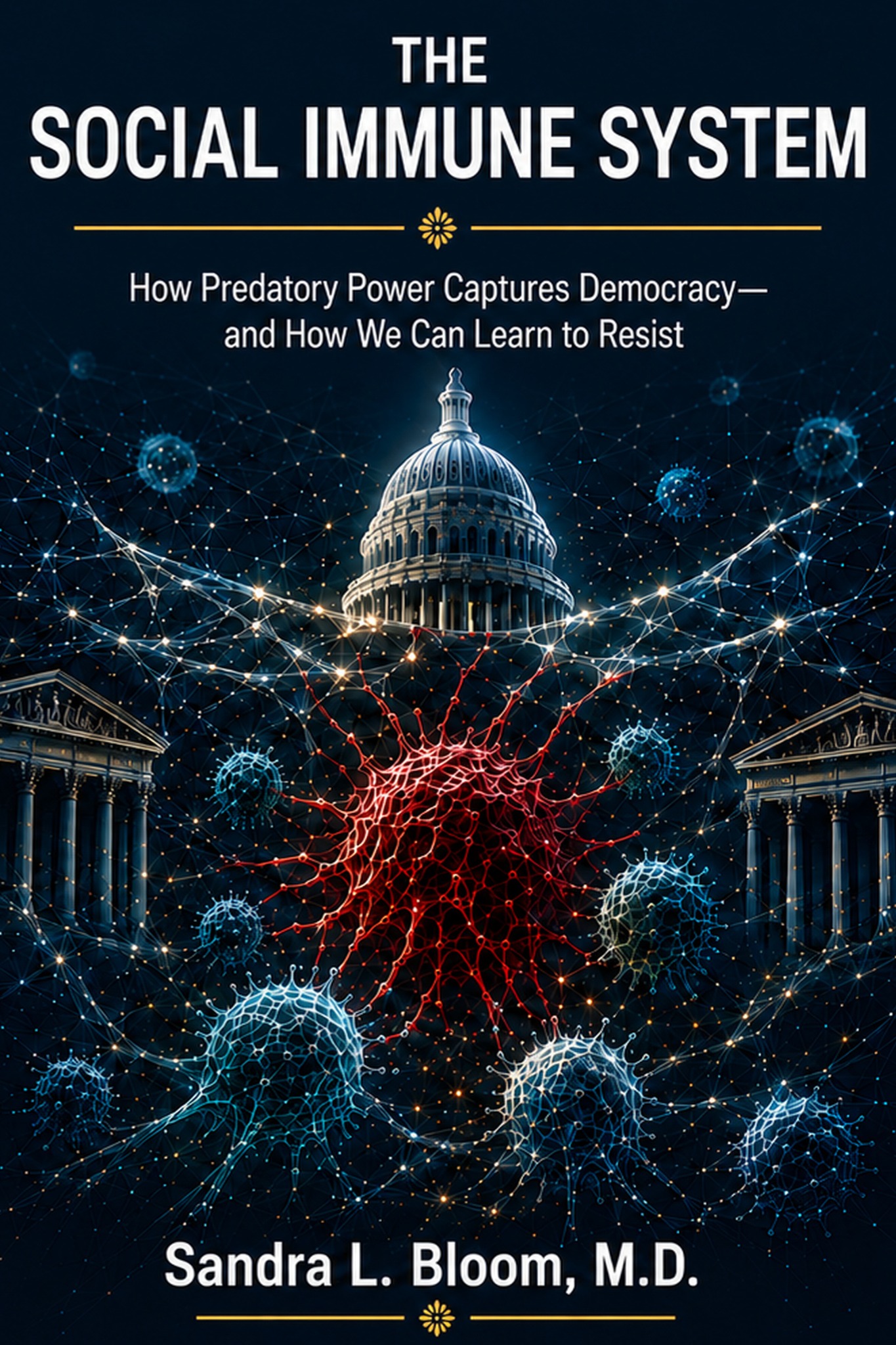
Cover of The Social Immune System by Sandra L. Bloom, M.D.

The question at the heart of the book

What helps a society protect itself?

Human societies depend on communication, memory, cooperation, boundaries, and repair. They are also vulnerable to power that turns those shared capacities toward a leader’s own preservation and expansion. Drawing on a lifetime of work with trauma and human systems, Sandra L. Bloom explores why that happens—and what makes resistance possible.

The body offers a useful starting point. Healthy immunity requires more than a forceful response: it requires recognizing danger accurately, tolerating harmless difference, coordinating protection, and limiting the harm of the response itself. Societies face related challenges.

Protection is collective work.

Explore the ideas

Recognizing predatory power
and strengthening our shared life

01

What is a predator?

In this book, a human predator is someone who repeatedly uses other people’s trust, vulnerability, labor, or dependence for personal advantage, with little regard for the harm caused. Other people become instruments for obtaining power, wealth, status, or control. The pattern may appear in an intimate relationship, a workplace, an institution, or public life.

The term directs attention to behavior and its consequences. Recognizing that pattern does not require assigning someone a psychiatric diagnosis. What matters is how the person treats others, whether limits are respected, and what happens when someone says no.

02

When does power become predatory?

Power becomes predatory when it is used to exploit the people and systems it should serve, and to protect the power holder from accountability. Authority, information, money, and institutional rules can all be turned toward personal preservation and expansion while the costs fall on others.

Warning signs gather into a pattern: deception that obscures harm, punishment of dissent, demands for personal loyalty, attacks on independent knowledge, and the weakening of safeguards that could restrain or remove a leader. The question is what power repeatedly does—and whether those affected can challenge it without retaliation.

03

Why do we miss the warning signs?

Predators may first appear as protectors. Attention, affection, charm, promises of safety, and a sense of belonging can establish trust before exploitation becomes visible. Our capacities for attachment, empathy, and loyalty help sustain human life; someone willing to exploit them can turn those strengths into leverage.

In public life, danger also arrives one event at a time. A lie, a dismissal, or a boundary violation comes wrapped in explanations while ordinary life continues. Dependence, fear, and repeated exposure can make harmful conditions seem normal. Recognition improves when we connect events, listen to people who bear the harm, preserve memory, and examine what happens when power encounters a limit.

04

Childhood is our first encounter with power

Children depend on people more powerful than they are. In those relationships, they learn whether power protects or dominates, whether disagreement is safe, whether rules apply to everyone, and whether harm can be acknowledged and repaired. These experiences help shape the capacities they later bring into schools, workplaces, and political life.

Childhood does not determine a person’s politics. But democratic life draws on developmental achievements: self-regulation, respect for other people’s perspectives, the ability to tolerate disagreement, and the capacity to accept limits on power. Obedience is not self-control. Silence is not emotional regulation. Submission is not maturity.

05

Our bodies show why protection needs restraint

Biological immunity involves interacting cells, tissues, and signals throughout the body. Some responses act quickly; others develop more targeted recognition and memory. Together they help control infection and support recovery. Regulation matters because protective responses can also damage us.

Immunodeficiency means that immune protection is inadequate. Autoimmunity involves immune responses against the body’s own components. Excessive or persistent inflammation can cause harm too. These are different problems, with different causes; they remind us that health cannot be reduced to “more defense.”

The social analogy is a guide to asking questions, not a diagnosis. Do warning signals reach us? Can institutions respond to genuine danger? Are people being attacked simply because they are different? Are we damaging the knowledge, relationships, and safeguards we need for protection? No group of people is a pathogen.

06

Intelligence is not maturity—and wisdom requires integration

Intelligence helps us acquire knowledge, recognize patterns, invent tools, and solve problems. It does not automatically give us restraint, compassion, or sound judgment about what those tools should serve. An individual or a society can become extraordinarily capable while remaining unable to manage power responsibly.

In this framework, wisdom means integration: bringing knowledge into relationship with emotion, memory, moral judgment, other people’s perspectives, our own limitations, and long-term consequences. Wisdom asks what an action will cost, who may be harmed, and what serves the larger whole. The challenge is to bring our growing intelligence into relationship with that wider responsibility.

07

Memory and repair make learning possible

History protects us when its lessons remain available and influence what we do next. Preserving records, teaching honestly, listening to people who have suffered, and protecting independent knowledge all contribute to social memory.

Repair gives that memory a future. After collective injury, truth-telling, accountability, mourning, and institutional change can help restore trust. A healthy society needs to remember danger without remaining permanently organized around fear.

Articles & Reflections

Ideas to read and share

What Is a Social Immune System?

A healthy society needs ways to recognize danger, contain abuses of power, tolerate difference, preserve memory, and repair harm. This essay introduces the idea at the heart of the book.

Read the article

A shared responsibility

Recognize danger.
Protect difference.
Make power accountable.

Power becomes predatory when it uses the larger system primarily for its own preservation and expansion. Healthy systems make power interruptible. They allow evidence to be heard, dissent to be protected, and wrongdoing to have consequences.

Each of us can strengthen a part of that protection: preserve memory, maintain professional standards, resist scapegoating, protect someone vulnerable, or teach children that disagreement does not end belonging. No one does everything. Social immunity is distributed.

Inside the Book

A look inside

Explore the dedication, browse the chapter listing, and read the opening of the book.

Dedication

To Jon Stewart, Stephen Colbert, John Oliver, Jimmy Kimmel, Seth Meyers, and all the political satirists who kept paying attention—and kept us laughing—when the rest of us wanted to close our eyes, stick our fingers in our ears, and hum until reality went away. You helped us stay sane.

Table of Contents
Prologue1
Part I. The Unfinished Species9
1. And Still It Happens10
2. Brilliant but Dangerous19
3. Radical Dependence and the Myth of Independence25
4. The Nursery That Made Humanity32
5. When Children Became Secondary39
6. The Childhood We Carry into Power58
Part II. When Predators Find Us78
7. Predators Among Us79
8. Why We Follow91
9. The Authoritarian Bargain100
10. The People Who Make Predation Possible107
Part III. The Captured Social Body117
11. How Capture Happens118
12. The Assault on Reality128
13. The Great Forgetting150
14. When Trauma Becomes a System167
Part IV. The Social Immune System184
15. What the Immune System Does185
16. Detecting the Predator202
17. Containing Power217
18. Memory, Repair, and Recovery231
Part V. Growing Up243
19. The Developing Social Immune System244
20. Democracy as a Developmental Achievement256
21. Breaking the Cycle266
22. Becoming a More Mature Species277
Notes286
Index309

Listen to the Prologue

The complete Prologue, read by Sandra L. Bloom. Approximately 31 minutes.

Read the Prologue

For book clubs and thoughtful conversations

Questions worth sitting with

Use these questions to connect the book’s ideas with your own experiences. Select a few for a group conversation, or return to them as you read.

  1. What did your earliest experiences teach you about what power is for? Have those lessons changed?
  2. How do you distinguish legitimate authority from power that protects itself at other people’s expense?
  3. When does a protective response become harmful? What helps a group recognize that boundary?
  4. What does your community remember well—and what is it encouraged to forget?
  5. Can you think of a decision that showed intelligence but lacked wisdom? What was missing?
  6. Which part of the social immune system could you strengthen in your own life?

Common questions

Does the immune-system metaphor dehumanize people?

It can if people are described as diseases or contaminants. This framework rejects that use. The ethical task is to distinguish harmful conduct from human difference, uphold rights, and impose limits without dehumanizing people.

Why do people follow destructive leaders?

Fear, humiliation, loss, and disconnection can make promises of certainty, protection, and belonging especially compelling. Understanding that vulnerability helps us ask how communities can meet those needs without scapegoating or submission to unchecked power.

Is democracy itself the social immune system?

Democratic institutions can provide essential safeguards: distributed authority, elections, independent courts, a free press, and protected dissent. Social immunity also depends on the relationships, habits, and ordinary acts that keep those structures working.

What gives this argument hope?

The capacities we need already exist. People cooperate, preserve memory, care for others, learn, and repair. The developmental challenge is to strengthen those capacities and bring them into relationship at the scale of modern societies.

About the author

Sandra L. Bloom, M.D.

Sandra L. Bloom is a psychiatrist, author, and organizational consultant whose work explores trauma, violence, and the conditions that allow people and human systems to heal. She originated the Sanctuary Model and developed Creating Presence, bringing a living systems perspective to organizational life.

The Social Immune System extends that inquiry to democracy: how we recognize predatory power, protect our shared capacities, and create healthier societies together.

Explore the book